[M-What Are You Z-Doing?]
So Your Fragile Voices Don't Melt Away
An Interview with Media Noon Representative Eunchong Cho
When we hear the word "youth," a familiar modifier often follows: "leaders of the future." The phrase places young people somewhere not yet arrived. Then who changes the world now? There is no single answer. Social problems are everywhere, and those who feel them step forward to address them.
Those born from the early 1980s to the early 2000s are called the Millennial Generation, and those born after are known as Generation Z. Together, they are often referred to as the MZ Generation. Not the future, but the youth of the present.
What do young people see as problems today? How are they moving to solve them? We asked the MZ generation: "M-What Are You Z-Doing?"
(Editor's Note)
Distinctive Commitments from a Distinctive Media Team
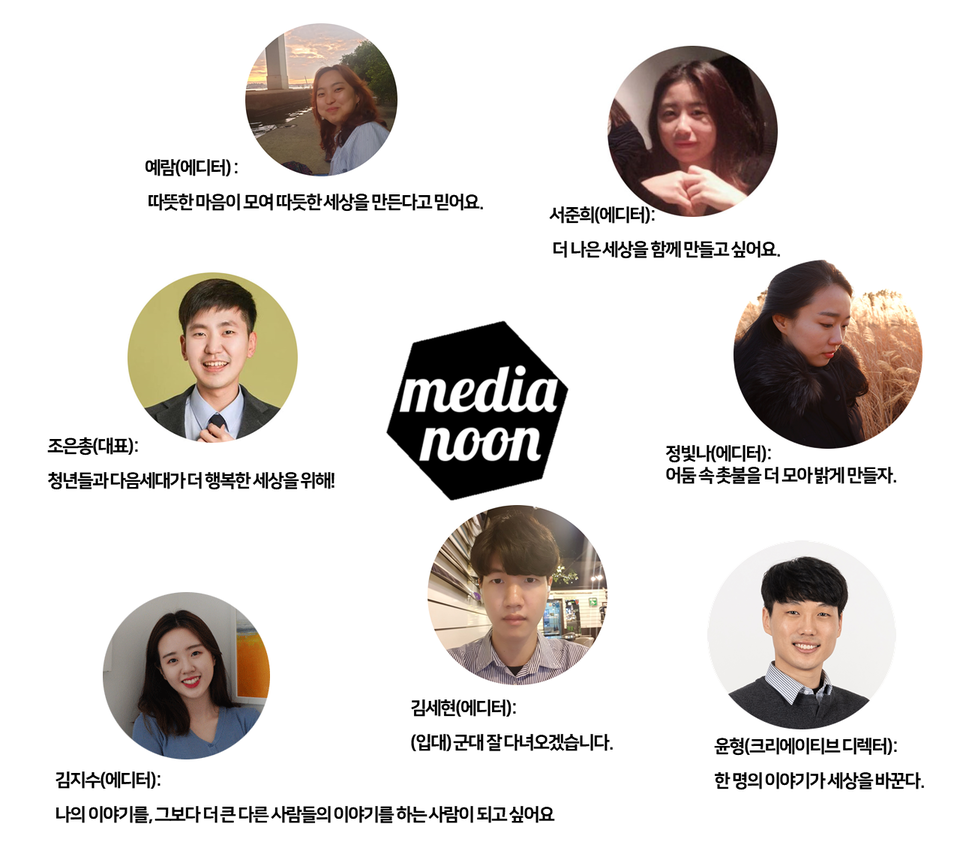
These are the uncommon resolutions of an uncommon media team:
- Eunchong Cho (Representative): For a happier world for youth and the next generation.
- Jung Bitna (Editor): Let's gather more candles in the dark and make them brighter.
- Yun Hyeong (Creative Director): One person's story can change the world.
- Seo Junhee (Editor): I want to create a better world together.
- Kim Sehyun (Editor): (Enlisting) I'll serve well and return safely from the military.
- Kim Jisoo (Editor): I want to be someone who tells my story - and even bigger stories beyond mine.
- Yeram (Editor): I believe warm hearts gathered together make a warmer world.
The word media originates from "middle." It is often translated as mass media or communications channels. In today's fast-changing society, speed has become a measure of media competitiveness - how quickly news can be delivered.
But amid this culture of speed, the nonprofit public-interest youth media collective Media Noon takes a different path. Their interview subjects, the volume of their reporting, the duration of their projects, and the way they connect people differ from conventional media.
They focus on those who have gone unnoticed. Even if they produce fewer stories, they engage in deep conversations with those involved and raise issues carefully and thoughtfully.
When All Voices Gather, They Become a Strong and Solid "Value"
In 2017, four young people with backgrounds in international organizations and NGOs gathered to discuss issues arising from differences in race and nationality. What began as a study group evolved into something more. Rather than only studying and talking, they began thinking about how to communicate social problems - and thus Media Noon was born.
Before founding Media Noon, Cho had worked in mainstream media. But she witnessed how even public-interest journalism could exclude stories that did not align with editorial directions. Important issues were ignored if they lacked immediate public appeal.
Media Noon was created to overcome these limitations.
Their guiding belief is: "Valuing Every Voice."
The word "Noon" means snow. Why choose something small and easily melted?
Cho explains: "Snow melts quickly, but when snow gathers, it becomes a massive snowball - solid and hard to melt. It represents people working together. It carries the meaning of thinking collectively about minority voices and empathizing with them."
Media Noon produces content, organizes talk concerts and book clubs, and runs a Youth Knowledge Community called Noon Lab - which serves as the starting point of that growing snowball.
Cho clarifies: "We don't think of ourselves as representing youth. We pursue media that works with youth. We created Noon Lab because we wanted to gather young people with similar concerns and amplify their stories."
Through Noon Lab, Media Noon shares its reporting processes and production methods, creating structures where even non-team members can collaborate.
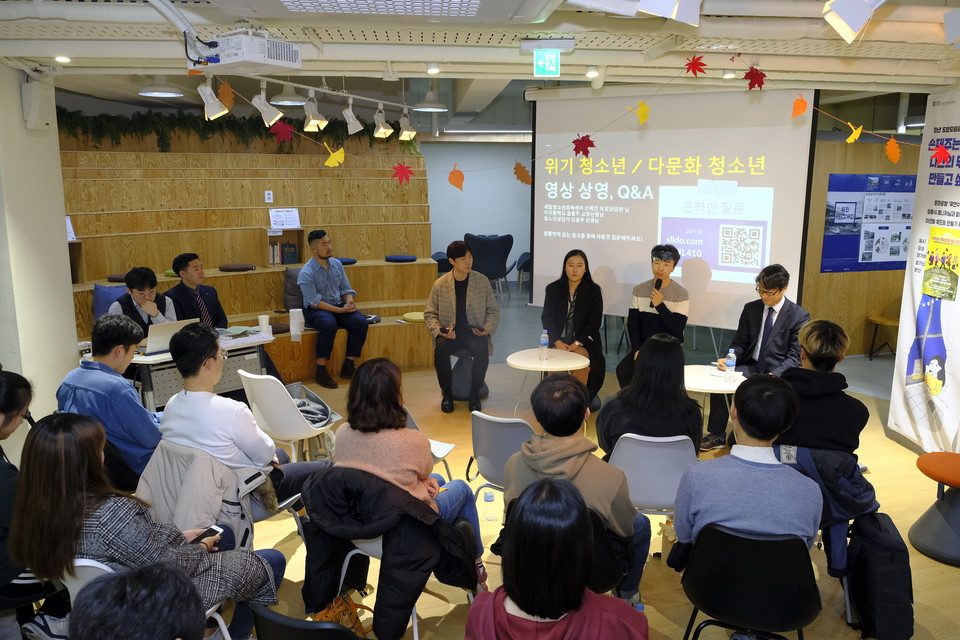
Toward the More Marginalized, the Darker Places - Where We Truly Need to Look
Cho recalls reporting on a 13-year-old charged with attempted murder.
Before committing the act, the child had endured domestic violence, dropped out of school, fallen in with harmful peer groups, and eventually locked himself in his room in isolation.
While mainstream media focused on strengthening juvenile punishment laws, Media Noon focused on the process - not just the result.
"Discussion about punishment is necessary. But if we do not pay attention to the process, similar tragedies will repeat. There are issues that may not attract immediate attention but demand collective reflection. Media must exist to carry those stories."
Cho describes Media Noon's approach as a form of solution journalism - though not in the sense of offering ready-made solutions.
"We are not prescribing medicine. We are reading the pain of the times and showing where solutions are needed."
Each Media Noon project begins with one team member's personal interest. That member studies the issue, contacts related stakeholders and civic organizations, meets various parties involved, and undergoes multiple internal discussions.
What may appear cumbersome is, in fact, careful consideration - ensuring marginalized voices are conveyed without violence or distortion.
Producing a story can take anywhere from three months to a year. Because short articles have limitations, projects often unfold in series. They produce not only articles but also videos and host talk concerts to convey voices more vividly.
"We are deeply interested in subjectively conveying the narratives of those experiencing social problems. Our goal is to capture what individuals and groups are experiencing in specific times and places."
"In a New Era, New Ideas Must Spread Through Society."
Media Noon has spotlighted voices such as:
- North Korean defector youth
- Migrant youth
- Out-of-school youth
- Young people living in the COVID era
Why focus so strongly on youth?
Cho responds: "Young people appear often in media. But their real perspectives are rarely represented - even when the writers themselves are young. Youth are portrayed as pitiful, as complainers, or as hopeful dreamers who will succeed if they just try hard enough."
If media truly reflected youth's concerns, she argues, it would challenge:
- The treatment of housing as a commodity and investment tool rather than a basic right
- Structural inequalities
- Policy failures
- The pain of young people who have lost motivation and become part of the so-called "N-po generation" (those who have given up multiple life milestones)
Today's youth inherited material prosperity but are fully exposed to hyper-competition and overheated market economies.
"Policy discussions focus on indicators and numbers. But the lived pain of youth is excluded. In a new era, new ideas must spread. We believe it is essential to convey the voices of young people struggling in this reality."
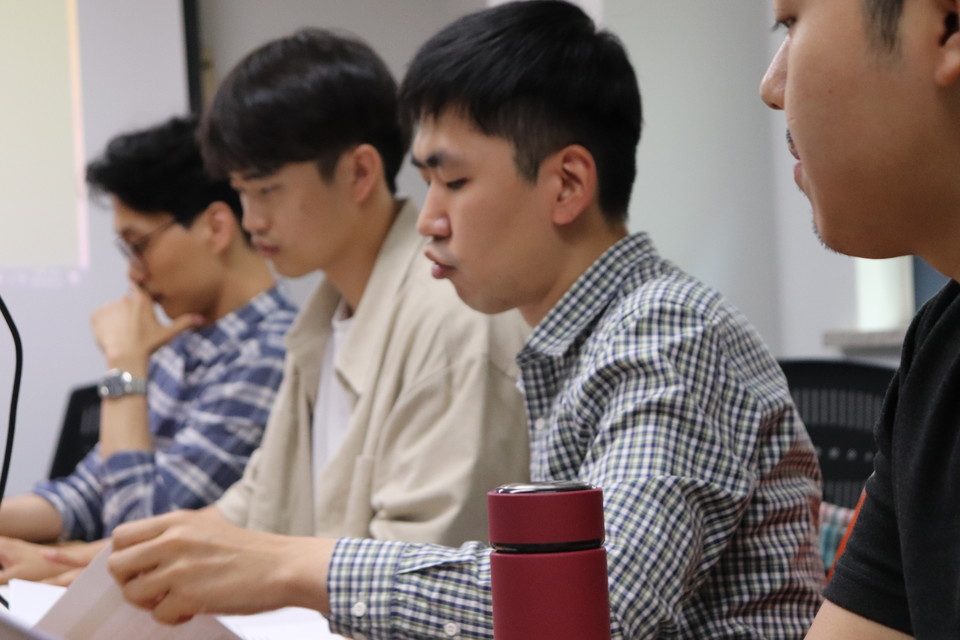
Walking Forward So Fragile Voices Do Not Melt Away
When asked whether she considers herself an innovator, Cho smiles shyly.
"Rather than following existing rules, I tend to create my own. Instead of fitting myself into a game, I adjust the environment so I can play a game that suits me. If that's innovation, then perhaps I am an innovator."
She adds: "I want to live a life that contributes to a healthy society and shares positive influence."
This year, Media Noon plans to continue engaging youth through Noon Lab, focusing on issues such as gender, human rights, youth, and the environment. They will also produce follow-up content on out-of-school youth and educational rights for children with disabilities.
Cho is also considering how Media Noon can become a sustainable workplace - a place where team members can feel pride in public-interest media work.
The role of a mediator is always important. Media can be edited for self-interest, distorted, or selectively silenced. When we hear only biased or cut voices, we grow only one ear and lose the ability to hear the other.
In a tilted playing field of information, Media Noon carries the real voices of youth and raises questions to a society sickened by rigid practices, structures, and numbers.
May they continue walking, distinctively and as solidly as the snowball their name evokes, so fragile voices do not disappear.
Original Korean source: Lifein, Mar 22, 2021.